On the evening of July 17, 2026, the Tsinghua University Student Innovation and Entrepreneurship Exchange Event at the 2026 World Artificial Intelligence Conference (WAIC) was held in Shanghai. The event was guided by the Academic Affairs Office and the Engineering Practice Education Center (iCenter) of Tsinghua University, co-hosted by the Tsinghua University Student Maker Space Association and WAIC Future Tech, and supported by the Openmind Research Institute as a co-organizer. Guests included Richard Sutton, laureate of the 2024 Turing Award; Bill Reichert, veteran Silicon Valley investor; Daniel Kammen, Member of the U.S. National Academy of Sciences and member of a Nobel Prize-winning team; as well as representatives from investment institutions, technology companies, and media, and more than 200 young university innovators and members of student innovation and entrepreneurship teams. Participants exchanged views on the development of artificial intelligence technologies, innovative practice, and youth talent cultivation.
Hu Chuxiong, Innovation and Entrepreneurship Coordinator of Tsinghua University and Deputy Director of the Academic Affairs Office, noted in his remarks that Tsinghua University has long attached great importance to innovation and entrepreneurship education. In the era of artificial intelligence, the university will continue to support young students in growing and thriving through innovative practice.
Zhang Qi, Director of the Innovation and Entrepreneurship Teaching Department of the Engineering Practice Education Center, stated that iCenter will continue to advance the development of engineering practice, engineering training, and innovation and entrepreneurship courses, and will support students in developing innovation and entrepreneurship projects and carrying out distinctive innovation and entrepreneurship activities.
Zhang Rongjian, Vice President of DONGHAOLANSHENG EXPO organizer of WAIC, said in his remarks that the event served to connect university innovation forces, industrial resources, and young entrepreneurs, and would help promote collaborative innovation and open cooperation.
Richard Sutton delivered a frontier-sharing presentation. He noted that artificial general intelligence is still in the process of development, with broad opportunities remaining in the next ten to twenty years. After the presentation, Hu Chuxiong presented Sutton with a model of Tsinghua University's Second Gate, and Sutton wrote a message for young students on a page of his book Reinforcement Learning: An Introduction.
During the investment sharing session, Bill Reichert pointed out that once a technology becomes viable, industrial competition will shift toward efficiency, cost, and innovation, and that entrepreneurship must be grounded in industry needs to create long-term value.
During the international perspective roundtable session, Daniel Kammen and other guests observed that AI is becoming a foundational capability across industries and should be further transformed into more accessible education and healthcare services.
During the roundtable session on industry-academia-research collaboration in embodied intelligence, Zhu Hao, co-founder and CTO of Manycore Tech; Shan Sicong, founding team member and Senior Vice President of BrainCo; Chen Mu, CTO of Xinggong Jujiang; and other outstanding Tsinghua alumni engaged in in-depth discussions with young students on frontier topics such as embodied intelligence, inference infrastructure, and the industrial deployment of AI.
Liu Renchen, Executive Vice President of the Research Institute of Tsinghua University in Shenzhen, delivered a special message for the event. Guests attending the event included Niu Kuiguang, Partner at IDG Capital; Zhang Han, Partner at Sequoia China; and Hu Xiaofang, Vice Chairman of the Beijing Science Education Development Foundation.
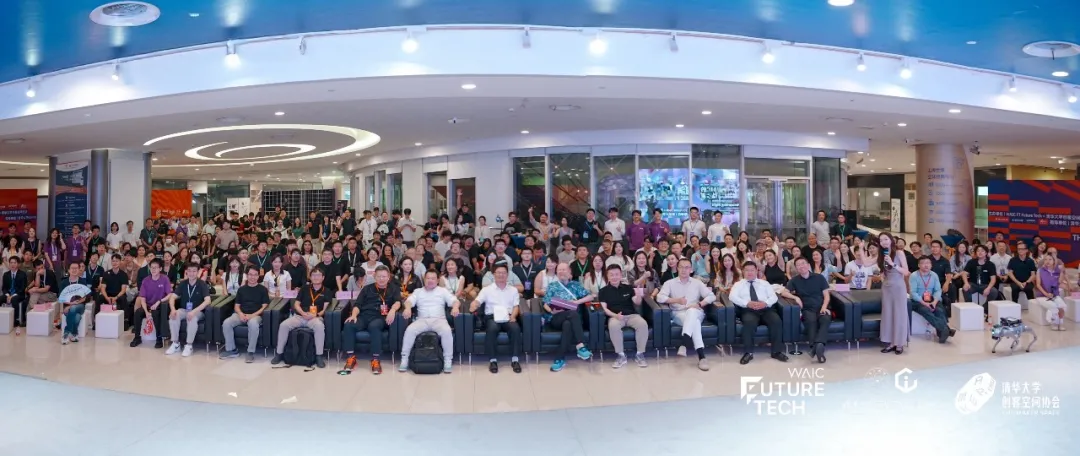
Group photo of participants at the event